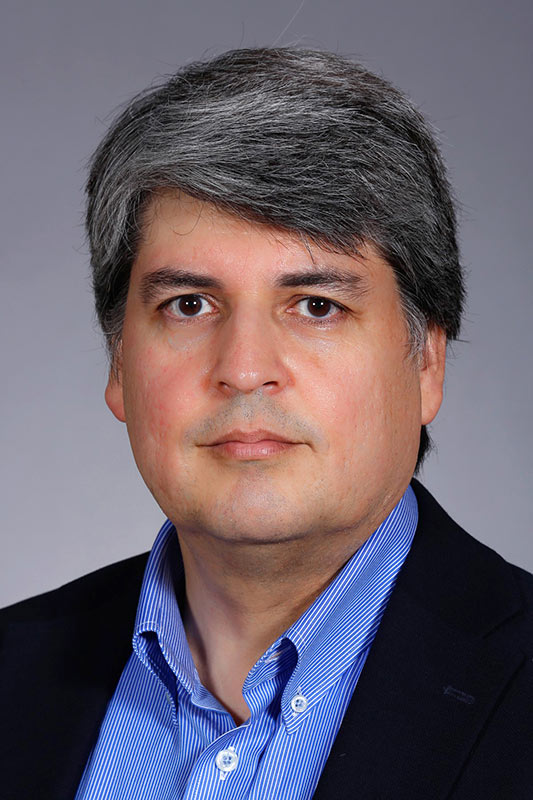
Department of Chemical and Biological Engineering

R. Dennis Vigil

Associate Professor and
Associate Chair

3037 Sweeney Hall
Iowa State University
Ames, IA 50011-2230

Phone (515)294-6438
Fax (515)294-2689
vigil@iastate.edu

Education
B.S., ChE, University of New Mexico, 1985
M.S., ChE, University of Michigan, 1986
Ph.D., ChE, University of Michigan, 1990

Honors and Awards
LEAD (Leadership in Engineering through Academic Diversity) special recognition award, College of Engineering, Iowa State University, 1997, 1998
Ford Foundation Postdoctoral Fellow, 1991-92
Michigan Minority Merit Scholar, 1985-1989
GEM Fellow, The University of Michigan, 1985-1986
Amoco Engineering Scholarship, The University of New Mexico, 1984
NASA Engineering Scholarship, The University of New Mexico, 1981

Teaching/Office Hours Schedule

Research Interests
The general objective of our research is to develop a better understanding of the interaction between chemical reaction and transport processes in multiphase systems, particularly in novel systems.

Other Information
American Institute of Chemical Engineers

Research Projects
Kinetics of Aggregation-Breakage Processes

Examples of coagulation, clustering, aggregation, breakage, and fragmentation are ubiquitous in nature and play an important role in processes as diverse as nanoparticle synthesis, blood coagulation, polymerization, crystallization, aerosol dynamics, and even galactic clustering. We are working to extend aggregation theory by developing new analytical and numerical solutions to population balance equations that incorporate both linear and collision-induced breakage mechanisms, as well as multiple components, and the relevance of these solutions to specific physical problems is being explored through the use of Brownian dynamics simulations and experiments.

Multiphase Couette-Taylor Flow
The vortex structure in a Couette-Taylor (CT) cell has applications to a variety of chemical processing problems, such as emulsion polymerization and extraction. For example, CT flow can be used to closely approximate a plug-flow reactor for sufficiently large rotation rates and annular gap widths. The optimization of these systems requires a fundamental understanding of the effect of various operational parameters on the hydrodynamic structure and mixing characteristics. Although there has been much progress in the understanding of homogeneous CT flow, relatively little is known about the behavior of multiphase CT flow. We are working to overcome this gap for liquid-liquid systems through the use of particle image velocimetry experiments and CFD calculations.

Reactive Precipitation in Stirred Tank Reactors
The production of metal powders with specific physical characteristics (such as surface area, density, and size distribution) is an important and difficult materials synthesis problem. Such processes often employ reductive precipitation in a semi-batch vessel, and the interaction between mixing, nucleation, growth, and agglomeration is complex. We are using a combination of computational fluid dynamics and moment closure expressions to model reactive precipitation.

Vibration-induced Mobilization of Oil Trapped in Porous Media
The development of methods for mobilizing residual organic liquids trapped in porous media is becoming increasingly important as world demand for oil increases and because of the need to remediate aquifers degraded by slow-dissolving organic contaminants. Low-frequency elastic wave stimulation is one such technique, but until recently the lack of a mechanistic understanding of the effects of vibration on mobilization of oil ganglia has prevented the method from being applied predictably in the field. In conjuction with our geophysicist collaborator, Prof. Igor Beresnev, we have developed a capillary-physics explanation to explain vibration-induced mobilization of trapped non-wetting organic fluids in porous media and have carried out bench-scale experiments to validate this mechanism. However, many issues remain unresolved before vibration-based mobilization techniques can be optimized and implemented reliably in the field, including delineating the effects of pore geometry, as well as the roles of viscous forces, surface wetting, and droplet breakup. We are currently working to extend our theory to account for these other factors through the use of mathematical analysis, computational fluid dynamics simulations, and flow visualization experiments.


Stochastic Simulation of Targeted Drug Delivery Minimization of side-effects requires precise targeting of drugs to diseased tissue. One promising method for achieving more selective delivery of drugs is to exploit differences in the number and type of receptors expressed by diseased and healthy cells. By encapsulating the drug in a carrier (for example liposomes) and populating the carrier with an appropriate combination of ligands that bind to the cell receptors, enhanced selectivity can be achieved. We are developing stochastic simulations of the interactions between cells and drug carriers in order to predict and optimize drug targeting.
 
Selected Publications

R. D. Vigil, I. Vermeersch, and R. O. Fox, “Destructive Aggregation: Aggregation with Collision-Induced Breakage,” Journal of Colloid and Interface Science, 302, 149-158 (2006).

Beresnev, I. A., Vigil, R. D., Li, W., Pennington, W. D., Turpening, R. D., Iassonov, P. P., and Ewing, R. P., “Elastic Waves Push Organic Fluids From Reservoir Rock,” Geophysical Research Letters, 32, L13303 (2005).

Wang, L., Olsen, M. D., and Vigil, R. D., “Reappearance of Azimuthal Waves in Turbulent Taylor-Couette Flow at Large Aspect Ratio,” Chemical Engineering Science, 60, 5555 (2005).

Li, W., Vigil, R. D., Beresnev, I. A., Iassonov, P., and Ewing, R., “Vibration-Induced Mobilization of Trapped Oil Ganglia in Porous Media: Experimental Validation of a Capillary Physics Mechanism,” Journal of Colloid and Interface Science, 289, 193 (2005).

Wang, L., Vigil, R. D., and Fox, R. O., “CFD Simulation of Shear-Induced Aggregation and Breakage in Turbulent Taylor-Couette Flow,” Journal of Colloid and Interface Science, 285, 167 (2005).

Wang, L., Marchisio, D. L., Vigil, R. D., and Fox, R. O., “CFD Simulation of Aggregation and Breakage Processes in Laminar Taylor-Couette Flow,” Journal of Colloid and Interface Science, 282, 380 (2005).

Marchisio, D. L., Pikturna, J. T., Fox, R. O., Vigil, R. D., and Barresi, A. A., “Quadrature Method of Moments for Population Balance Equations,” American Institute of Chemical Engineers Journal, 49, 1266 (2003).

Marchisio, D. L., Vigil, R. D., and Fox, R. O., "Quadrature Method of Moments for Aggregation-Breakage Processes," Journal of Colloid and Interface Science, 258, 322 (2003).